Giuseppina Saffiotti
The Florios of SicilyGiuseppina Saffiotti is Paolo Florio’s wife and the mother of Vincenzo, but her place in the Florio household is defined as much by constrained choice as by kinship. The narrative follows her from an earthquake in Bagnara through relocation, pregnancy and loss, her husband’s illness and death, and her later efforts to secure the family’s future. Across those changes, she is at once a caregiver, a woman economically and socially subordinated to men, and an outspoken critic of the arrangements that have governed her life.
Identity and Family Background
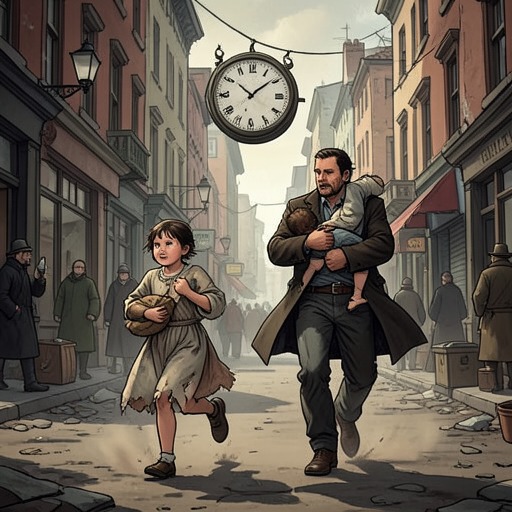
During the earthquake, Giuseppina wakes to the danger facing her infant son, Vincenzo, and reaches for the cradle as it sways in the tremors. She manages to take him from it. Her maternal response is immediate: she acts to protect her child while the adults try to escape the unstable house. In another moment of the same crisis, she comforts Vincenzo and makes room for Vittoria, Paolo’s orphaned niece, who has been left in the care of Paolo and Giuseppina after her parents’ deaths. Giuseppina’s household therefore includes both her own child and a bereaved girl dependent on the family for shelter and a home.
That family role does not make her secure in her own home. When Paolo announces that they must leave Pietraliscia and get away from Bagnara, Giuseppina resents his claim that the house belongs to them both. She remembers the dowry she brought, and the repeated negotiations required to satisfy the Florios’ demands for money before she married. She had not wanted the marriage; now Paolo proposes to leave the house that came with her dowry. Her reaction reveals how property, marriage, and family authority overlap: the language of shared possession cannot erase her memory of what she contributed or how little power she had in the match.
Displacement and Unequal Marriage
Giuseppina experiences the move from Bagnara to Palermo not as a fresh start but as an uprooting imposed on her. At the pier, her sister Mattia tries to comfort her and says that wives are their husbands’ property and have no power. Giuseppina understands the rule Mattia describes, but the narrative also makes clear that submission does not guarantee kindness: in her marriage to Paolo, the husband’s authority exists alongside his failure to treat his wife well. Her resentment is not simply a refusal to adapt to a new city; it is tied to a life in which men have repeatedly decided where she will live and what her marriage will mean.
Years later, Giuseppina confronts Paolo over the family’s history. When he describes his sister as having chosen to marry a man he dislikes, Giuseppina rejects the premise that women freely choose their marriages. She points out that the girl had been fourteen when Paolo’s father married her off, and connects that history to her own experience of being brought to Palermo by Paolo. Paolo answers by citing the family’s improved circumstances, his earnings, and the clothes and furniture he has provided. Giuseppina counters that material improvements do not cancel the indignity of their conditions or the limits placed on her. Their argument sets financial provision against autonomy: Paolo presents what he can buy as proof of a better life, while Giuseppina insists that comfort cannot make an imposed marriage voluntary.
Pregnancy, Loss, and Care
In Palermo, Giuseppina becomes pregnant. She recognizes the pregnancy after missing her cycle and noticing soreness in her breasts, but the prospect of expecting a child in a house she experiences as dark and oppressive adds to her distress. The pregnancy ends in a miscarriage. When Vittoria notices the blood, Giuseppina realizes what is happening and collapses before she can do more than ask for the midwife. Vittoria runs barefoot over the wet paving stones to find Mariuccia, the midwife from Bagnara.
During the miscarriage, Ignazio carries Giuseppina when she is too weak to continue. She tells him that he is the one who is there for her, not Paolo. Her words are quiet, but they disclose the emotional distance in her marriage and the care she receives from her brother-in-law. The scene links physical dependence to a wider pattern: Giuseppina’s closest support does not come from the husband who holds authority over her life. Later, when Paolo’s tuberculosis has become severe, she remains beside him through his worsening illness. She watches him struggle to breathe while Ignazio comes to help and arranges for someone to cover the shop. In the sickroom, she is again the person attending to a husband whose needs dominate the household.
Paolo’s Death and Giuseppina’s Grief
As Paolo’s illness advances, Mattia returns to the family and voices her anger at being sent away by her brother. She says that she loves him but cannot accept the grudge that has separated them, and Giuseppina brings her to bed and tries to calm her. Their closeness is described as sisterhood without shared blood. Giuseppina’s care thus extends beyond the immediate work of nursing Paolo: she also offers Mattia a place to grieve and be comforted, even as the family conflict remains unresolved.
After Paolo dies, Ignazio finds Giuseppina sitting at the foot of the bed. She does not speak or cry; she clutches her rosary and asks for Paolo’s good clothes. Ignazio takes up the practical tasks, including arranging the funeral, closing the store for two days, and writing to Mattia and relatives in Bagnara. Giuseppina’s silence marks a change in her circumstances without suggesting that the loss is simple or complete. Her marriage had been troubled, yet she has spent its final days beside Paolo, and his death leaves the family to manage both private grief and public obligations.
Family Duty and the Next Generation
After Ignazio’s death, Giuseppina turns toward Vincenzo and the succession of Casa Florio. At fifty-four, she believes he cannot be left alone and that the family requires a wife and heirs. She sees what Ignazio and Vincenzo have built as an inheritance that must be protected, and concludes that this requires a woman raised as a lady and what she calls good blood. Her reasoning shows how closely she has absorbed the family’s concerns with lineage and continuity. Having had little control over her own marriage, she now considers the choice of Vincenzo’s wife as a matter of family preservation.
That concern later becomes a direct conflict between generations. Giulia tells Vincenzo that, for years, she and their children lived without rights and in fear that he would cast her aside to marry a noblewoman chosen by his mother. She refuses to let their daughters, Angela and Giuseppina, be made to endure the humiliation she experienced, or be married to men who despise them for the sake of Vincenzo’s interests and Casa Florio. Vincenzo answers that he did marry Giulia; Giulia argues that he did so because he had a son and needed to legitimize his heir. The exchange gives concrete consequences to Giuseppina’s dynastic outlook: the effort to safeguard the family through a socially advantageous marriage becomes, in the next generation, part of the pain her daughter-in-law names and rejects.
Narrative Significance
Giuseppina’s story exposes the difference between family affection and family power. She cares for Vincenzo, helps Vittoria and Mattia, and remains beside Paolo during his final illness; at the same time, her marriage, home, and movements are shaped by decisions she did not freely make. Her life also places domestic experience alongside the Florios’ commercial ascent. The family’s business grows through networks of imported spices and storage in Palermo, while Giuseppina’s own security remains tied to marriage, dowry, household labor, and her son’s future.
Her most consequential contradiction is that she both suffers under patriarchal expectations and later invokes lineage and marriage to protect the family her son inherits. The narrative does not reduce this to a simple reversal: the pressure to preserve Casa Florio is real, but so are the costs borne by women expected to secure that future. Giulia’s refusal to let her daughters repeat her humiliation makes those costs explicit. Through Giuseppina’s choices and the consequences they set in motion, the family’s continuity appears not as an abstract inheritance but as a system whose burdens are distributed unequally across generations.